Morse code prosigns
A prosign is two or more letters sent as one character, with no letter gap between them. Operators write one with a line over it. Tap one to hear it.
Why a prosign has no letter gap
ITU-R M.1677-1 leaves three units between letters and one between the marks inside a letter. A prosign takes the one-unit gap all the way through, so a receiver hears a single character rather than two letters. In typed text it goes in angle brackets, as <AR>, which is how the translator reads it too.
Prosign by prosign
What each one means, how it is said, and whether ITU-R M.1677-1 defines it. A punctuation mark shares its code with 4 of them.
SOS
...---...
- Means
- International distress signal
- Said
- di-di-di-dah-dah-dah-di-di-dit
- Standard
- Common use
The distress signal adopted by the International Radiotelegraph Conference in Berlin in 1906, which wrote it as one group of nine marks. It isn’t in ITU-R M.1677-1.
AR
.-.-.
- Means
- End of message
- Said
- di-dah-di-dah-dit
- Standard
- ITU-R M.1677-1
- Same as
- Plus
ITU-R M.1677-1 ends every telegram with it. Followed by K, it ends a transmission and hands over to the other station.
AS
.-...
- Means
- Wait / stand by
- Said
- di-dah-di-di-dit
- Standard
- ITU-R M.1677-1
- Same as
- Ampersand
Under ITU-R M.1677-1, a station that is called but can’t receive yet sends it, and gives the reason if the wait will run past ten minutes.
BT
-...-
- Means
- Break between sections
- Said
- dah-di-di-di-dah
- Standard
- ITU-R M.1677-1
- Same as
- Double hyphen
ITU-R M.1677-1 calls it the double hyphen and uses it to separate the parts of a telegram, such as the address from the text.
SK
...-.-
- Means
- End of contact
- Said
- di-di-di-dah-di-dah
- Standard
- ITU-R M.1677-1
ITU-R M.1677-1 calls it the end of work signal. The station that sent the last telegram sends it.
KN
-.--.
- Means
- Go ahead, named station only
- Said
- dah-di-dah-dah-dit
- Standard
- Common use
- Same as
- Open parenthesis
CT
-.-.-
- Means
- Attention / starting signal
- Said
- dah-di-dah-di-dah
- Standard
- ITU-R M.1677-1
ITU-R M.1677-1 calls it the starting signal, to be sent before every transmission.
SN
...-.
- Means
- Understood
- Said
- di-di-di-dah-dit
- Standard
- ITU-R M.1677-1
HH
........
- Means
- Error — start again
- Said
- di-di-di-di-di-di-di-dit
- Standard
- ITU-R M.1677-1
ITU-R M.1677-1 calls it the error signal: eight dits, the most in a row anywhere in the table.
K
-.-
- Means
- Invitation to transmit (over)
- Said
- dah-di-dah
- Standard
- ITU-R M.1677-1
Under ITU-R M.1677-1, a call ends with it: the call sign of the station wanted, DE, the caller’s own call sign, then K. The reply ends the same way.
How a contact opens and closes
ITU-R M.1677-1 sets the order the prosigns come in, from the first call to the last signal.
The caller sends the call sign of the station it wants, no more than twice, then DE, its own call sign, and K, the invitation to transmit.
The station called answers the same way. If it can’t take a message yet, it sends AS, the wait signal.
Inside a message, BT separates the parts, such as the address from the text and the text from the signature.
AR ends each message. AR followed by K ends the transmission and hands over to the other station.
SK ends the work. The station that sent the last message sends it.
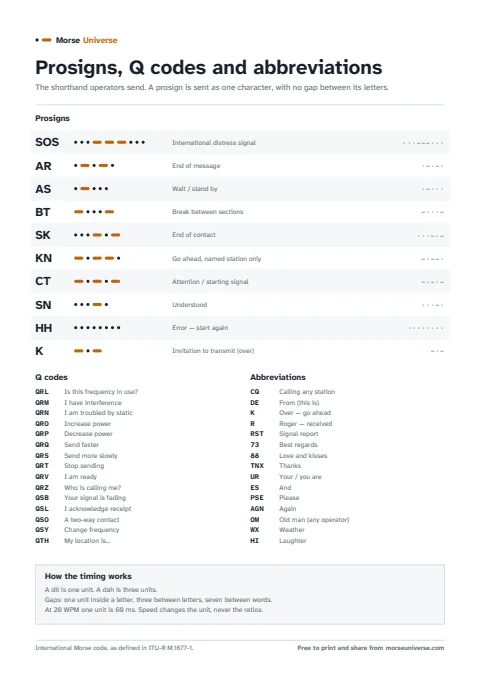
Prosigns and Q codes chart
The prosigns, Q codes and abbreviations on one printable sheet, drawn to the same scale as this page.
Open the printable chart page for the ink-saver version and the other five sheets.
Questions
What is a prosign in morse code?
Two or more letters sent as one character, with no letter gap between them. Operators use them to run a contact: to say a message is over, to ask for a wait, or to sign off.
What does AR mean in morse code?
End of message. AR is di-dah-di-dah-dit, A and R run together, and ITU-R M.1677-1 ends every telegram with it.
What does SK mean in morse code?
End of work: the contact is over. SK is di-di-di-dah-di-dah, S and K run together into one character.
How do you end a message in morse code?
With AR, sent as one character. Add K after it if the other station should reply, or send SK if the contact is over.
How do you sign off in morse code?
With SK, the end of work signal, once the last message has been sent. Under ITU-R M.1677-1, the station that sent that message is the one to send it.
More morse tools
- Morse code punctuation
Every punctuation mark and accented letter, played aloud.
- SOS in morse code
Hear it, watch it flash and learn to blink it with a flashlight.
- Morse code alphabet
A to Z, each letter played aloud, with how to say it.
Sources
- Codes and timing follow Recommendation ITU-R M.1677-1 (10/2009), International Morse code (International Telecommunication Union, 2009).
- International Radiotelegraph Conference (Berlin, 1906) (International Telecommunication Union).