Morse code alphabet
Each letter from A to Z is one to four marks: dits (short signals) and dahs (long ones, three times as long). Tap a letter to hear it.
Learn the letters by sound
ARRL advises learning each letter as a rhythm you hear, not as a picture of marks to count. Operators say the rhythm out loud: a dah is “dah”, and a dit is “di” when another mark follows it and “dit” at the end. So A is di-dah and B is dah-di-di-dit.
Play a letter above, say its reading along with it, and the list below gives the reading for every letter.
Letter by letter
Each letter with its reading, the character its marks spell backwards, and where it turns up in real sending.
A
.-
- Said
- di-dah
- Backwards
- N
A opens two of the prosigns in ITU-R M.1677-1: AR ends a message, and AS asks the other station to wait.
B
-...
- Said
- dah-di-di-dit
- Backwards
- V
BT, the break between sections, is the only prosign in the ITU table built on B.
C
-.-.
- Said
- dah-di-dah-dit
- Backwards
- Ä
C starts CQ, the call to any station listening, and CT, the prosign that says a transmission is beginning.
D
-..
- Said
- dah-di-dit
- Backwards
- U
D opens DE, which means from: it sits between the station being called and the station calling.
E
.
- Said
- dit
- Backwards
- The same both ways
One dit (the short signal), the shortest code in the table. Run an E into a following T with no gap between them and a receiver hears A instead.
F
..-.
- Said
- di-di-dah-dit
- Backwards
- L
No prosign or Q-code in the tables uses F. Its four marks are L's read backwards, so the two are easy to send for each other.
G
--.
- Said
- dah-dah-dit
- Backwards
- W
G turns up in AGN, the shorthand for again, which asks the other operator to repeat what was missed.
H
....
- Said
- di-di-di-dit
- Backwards
- The same both ways
H is four dits. HH, eight of them in a row, is the ITU signal for an error: stop, then start the word again.
I
..
- Said
- di-dit
- Backwards
- The same both ways
I ends HI, which operators send as laughter.
J
.---
- Said
- di-dah-dah-dah
- Backwards
- Ö
J is the only letter sent as one dit and three dahs (the long signal). Drop a dah and it reads as W; add one and it is the figure 1.
K
-.-
- Said
- dah-di-dah
- Backwards
- The same both ways
K sent on its own is the ITU invitation to transmit, the prosign for over. KN says the invitation is for one named station only.
L
.-..
- Said
- di-dah-di-dit
- Backwards
- F
L turns up in QRL, the Q-code that asks whether a frequency is already in use.
M
--
- Said
- dah-dah
- Backwards
- The same both ways
M turns up in QRM, the Q-code for interference from another station.
N
-.
- Said
- dah-dit
- Backwards
- A
QRN reports static, and N closes the prosigns KN and SN.
O
---
- Said
- dah-dah-dah
- Backwards
- The same both ways
O is three dahs, and the middle of SOS, which is sent as one run of nine marks with no letter gaps.
P
.--.
- Said
- di-dah-dah-dit
- Backwards
- The same both ways
P opens PSE, the shorthand for please, and QRP, the Q-code that asks the other station to cut power.
Q
--.-
- Said
- dah-dah-di-dah
- Backwards
- Y
Every Q-code in the table starts with Q, from QRL to QRZ.
R
.-.
- Said
- di-dah-dit
- Backwards
- The same both ways
R sent on its own means received. It also ends AR, the prosign for the end of a message.
S
...
- Said
- di-di-dit
- Backwards
- The same both ways
S is three dits, the first and last letter of SOS, and it opens SK, the prosign that ends a contact.
T
-
- Said
- dah
- Backwards
- The same both ways
One dah, and the second half of BT and CT, the prosigns for a section break and the start of a transmission.
U
..-
- Said
- di-di-dah
- Backwards
- D
U opens UR, the shorthand operators send for your or you are.
V
...-
- Said
- di-di-di-dah
- Backwards
- B
V turns up in QRV, the Q-code that says a station is ready.
W
.--
- Said
- di-dah-dah
- Backwards
- G
W opens WX, the shorthand for weather.
X
-..-
- Said
- dah-di-di-dah
- Backwards
- The same both ways
X closes WX, the shorthand for weather. Its marks read the same in both directions.
Y
-.--
- Said
- dah-di-dah-dah
- Backwards
- Q
Y ends QSY, the Q-code that asks the other station to move to another frequency.
Z
--..
- Said
- dah-dah-di-dit
- Backwards
- Ü
Z ends QRZ, the Q-code that asks who is calling.
Letters that mirror each other
Read a letter’s marks from the end and 6 pairs turn into each other. Knowing one letter of a pair gives you the other.
- AN
- BV
- DU
- FL
- GW
- QY
E, H, I, K, M, O, P, R, S, T and X read the same both ways. C, J and Z turn into Ä, Ö and Ü, accented letters that have codes of their own outside the ITU standard.
Why a dah is drawn three dits long
ITU-R M.1677-1 times morse in units. A dit lasts one unit and a dah three. The marks inside a letter are one unit apart, letters three units and words seven. Every drawing on this page keeps those lengths.
Speed is measured on the word PARIS, which fills 50 units with the gap after it. At 20 words per minute (WPM), one unit lasts 60 milliseconds.
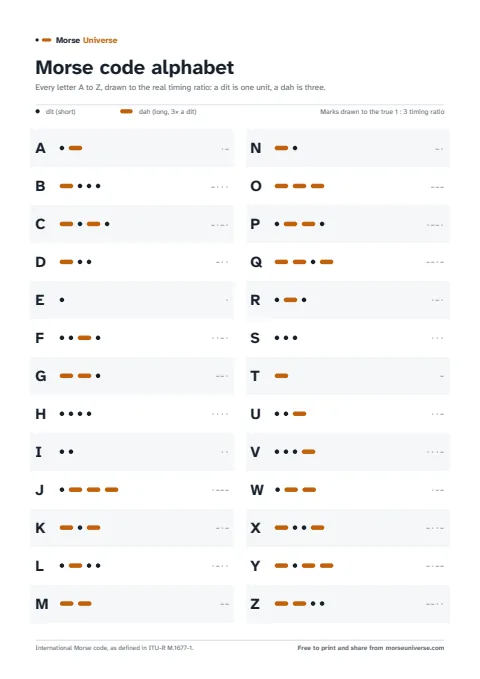
Alphabet chart
A to Z on one printable sheet, drawn to the same scale as this page.
Open the printable chart page for the ink-saver version and the other five sheets.
Questions
How many letters are in the morse code alphabet?
26, from A to Z. ITU-R M.1677-1, the international standard, codes them alongside the digits 0 to 9, the punctuation marks and a few accented letters. Operators also send prosigns, letters run together into one character, and Q codes, three letters that stand for a whole question or answer.
Does morse code have capital letters?
No. Each letter has a single code, so A and a are sent the same way.
Which letters are shortest in morse code?
E and T, with one mark each: E is a single dit and T a single dah. See what a single dot means and what a single dash means.
Which letters take longest to send?
J, Q and Y. Each is three dahs and a dit, 13 units with the gaps inside the letter, which is 0.78 seconds at 20 WPM.
How do you learn the morse code alphabet?
By sound: play a letter, say its reading out loud, and move on once you know it on hearing rather than by counting marks. Is morse code hard to learn? covers how long it takes.
More morse tools
- Morse code translator
Type any text to hear it in morse, or paste morse to read it.
- Morse code numbers
The digits 0 to 9, each played aloud, and a box for any number.
- Printable morse code chart
Every letter and number drawn to scale, for US Letter and A4.
Sources
- Codes and timing follow Recommendation ITU-R M.1677-1 (10/2009), International Morse code (International Telecommunication Union, 2009).
- Learning morse code (American Radio Relay League).