Q codes for ham radio
A Q code is three letters starting with Q that stand for a whole question or answer. These are the 24 that ARRL lists as the ones hams use most. Tap one to hear it.
How a Q code asks a question
ITU-R M.1172 gives every Q code two meanings. Sent on its own it answers or advises; followed by a question mark it asks. Figures, a call sign or a place can follow to fill in the blank, and a few codes take C after them for yes or NO for no.
Q code by Q code
The question and answer are ITU-R M.1172’s, with the optional parts left out. Three dots mark the blank the sender fills in.
QRG
--.- .-. --.
- Question
- Will you tell me my exact frequency?
- Answer
- Your exact frequency is … kHz (or MHz).
- Standard
- ITU-R M.1172
QRL
--.- .-. .-..
- Question
- Are you busy?
- Answer
- I am busy. Please do not interfere.
- Standard
- ITU-R M.1172
ARRL says hams mostly send it to ask whether a frequency is already in use before calling on it.
QRM
--.- .-. --
- Question
- Is my transmission being interfered with?
- Answer
- Your transmission is being interfered with … (1 nil, 2 slightly, 3 moderately, 4 severely, 5 extremely).
- Standard
- ITU-R M.1172
QRN
--.- .-. -.
- Question
- Are you troubled by static?
- Answer
- I am troubled by static … (1 nil to 5 extremely, as for QRM).
- Standard
- ITU-R M.1172
QRO
--.- .-. ---
- Question
- Shall I increase transmitter power?
- Answer
- Increase transmitter power.
- Standard
- ITU-R M.1172
QRP
--.- .-. .--.
- Question
- Shall I decrease transmitter power?
- Answer
- Decrease transmitter power.
- Standard
- ITU-R M.1172
QRQ
--.- .-. --.-
- Question
- Shall I send faster?
- Answer
- Send faster (… words per minute).
- Standard
- ITU-R M.1172
QRS
--.- .-. ...
- Question
- Shall I send more slowly?
- Answer
- Send more slowly (… words per minute).
- Standard
- ITU-R M.1172
QRT
--.- .-. -
- Question
- Shall I stop sending?
- Answer
- Stop sending.
- Standard
- ITU-R M.1172
QRU
--.- .-. ..-
- Question
- Have you anything for me?
- Answer
- I have nothing for you.
- Standard
- ITU-R M.1172
QRV
--.- .-. ...-
- Question
- Are you ready?
- Answer
- I am ready.
- Standard
- ITU-R M.1172
QRX
--.- .-. -..-
- Question
- When will you call me again?
- Answer
- I will call you again at … hours on … kHz (or MHz).
- Standard
- ITU-R M.1172
ARRL notes that between hams, minutes are usually meant rather than hours.
QRZ
--.- .-. --..
- Question
- Who is calling me?
- Answer
- You are being called by … (on … kHz or MHz).
- Standard
- ITU-R M.1172
QSB
--.- ... -...
- Question
- Are my signals fading?
- Answer
- Your signals are fading.
- Standard
- ITU-R M.1172
QSK
--.- ... -.-
- Question
- Can you hear me between your signals, and if so may I break in on your transmission?
- Answer
- I can hear you between my signals; break in on my transmission.
- Standard
- ITU-R M.1172
QSL
--.- ... .-..
- Question
- Can you acknowledge receipt?
- Answer
- I am acknowledging receipt.
- Standard
- ITU-R M.1172
QSO
--.- ... ---
- Question
- Can you communicate with … direct (or by relay)?
- Answer
- I can communicate with … direct (or by relay through …).
- Standard
- ITU-R M.1172
Hams also use QSO as a noun for the contact itself.
QSP
--.- ... .--.
- Question
- Will you relay to … free of charge?
- Answer
- I will relay to … free of charge.
- Standard
- ITU-R M.1172
QST
--.- ... -
- Means
- General call preceding a message addressed to all amateurs and ARRL members.
- Standard
- ARRL
ITU-R M.1172 doesn’t define it; ARRL does, and calls it in effect CQ ARRL. It has no question form.
QSX
--.- ... -..-
- Question
- Will you listen to … on … kHz (or MHz)?
- Answer
- I am listening to … on … kHz (or MHz).
- Standard
- ITU-R M.1172
QSY
--.- ... -.--
- Question
- Shall I change to transmission on another frequency?
- Answer
- Change to transmission on another frequency (or on … kHz or MHz).
- Standard
- ITU-R M.1172
QTC
--.- - -.-.
- Question
- How many telegrams have you to send?
- Answer
- I have … telegrams for you.
- Standard
- ITU-R M.1172
ARRL’s list reads telegrams as messages.
QTH
--.- - ....
- Question
- What is your position in latitude and longitude?
- Answer
- My position is … latitude, … longitude.
- Standard
- ITU-R M.1172
Hams use it for location in general. ARRL gives the question as “What is your location?”
QTR
--.- - .-.
- Question
- What is the correct time?
- Answer
- The correct time is … hours.
- Standard
- ITU-R M.1172
ITU-R M.1172 gives all times in UTC unless the question or answer says otherwise.
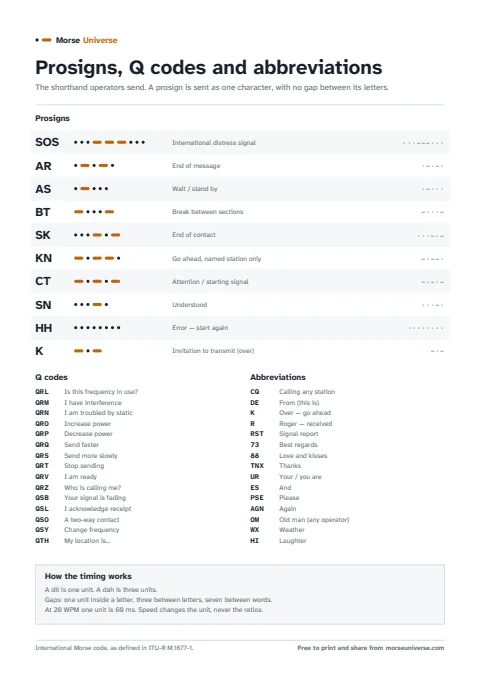
Prosigns and Q codes chart
15 of these Q codes, with the prosigns and abbreviations, on one printable sheet drawn to the same scale as this page.
Open the printable chart page for the ink-saver version and the other five sheets.
Questions
What are Q codes?
Three-letter groups starting with Q, each standing for a set question or answer, so a whole sentence goes in three letters. ITU-R M.1172 defines the series from QOA to QUZ, and hams use a few dozen of them, on voice as well as in morse.
What does QSL mean in ham radio?
I acknowledge receipt. Sent as QSL? with a question mark, it asks the other station to confirm it got your message.
What does QTH mean?
My location is. ITU-R M.1172 defines it as a position in latitude and longitude, but hams use it for location in general, and QTH? asks where the other station is.
What does QRZ mean?
Who is calling me? The answer is QRZ followed by the call sign of the station calling.
What does QRP mean in ham radio?
Decrease transmitter power, or as QRP?, shall I decrease it? Its opposite is QRO, increase power.
What does QSO mean in ham radio?
A contact between two stations. ITU-R M.1172 defines QSO? as asking whether you can communicate with a station, directly or by relay, and hams use the word for the contact itself.
More morse tools
- Morse code prosigns
AR, SK, KN and the rest, each sent as one character.
- How to learn morse code
Learn by ear with the Koch method, in rounds of 20.
- Morse code alphabet
A to Z, each letter played aloud, with how to say it.
Sources
- Recommendation ITU-R M.1172: Miscellaneous abbreviations and signals to be used for radiocommunications in the maritime mobile service (International Telecommunication Union, 1995).
- Q-Signals (American Radio Relay League).
- Codes and timing follow Recommendation ITU-R M.1677-1 (10/2009), International Morse code (International Telecommunication Union, 2009).