Thank you in morse code
Eight letters in two words, 22 marks in all. Press Play to hear it and see it blink. On the air, operators send TU, four marks long.
- .... .- -. -.- / -.-- --- ..-
The flashlight needs camera access. Nothing is recorded or sent.
How to blink Thank you with a flashlight
Count a steady beat. A dit (the short signal) is one count of light, and a dah (the long one) is three. Stay dark for one count between flashes and three counts between letters.
- T: one long flash.
- H: four short flashes.
- A: one short, one long.
- N: one long, one short.
- K: one long, one short, one long.
- Stay dark for seven counts before the next word.
- Y: one long, one short, two long.
- O: three long flashes.
- U: two short, one long.
- Stay dark for seven counts, then start again from the first letter.
Download Thank you in morse code
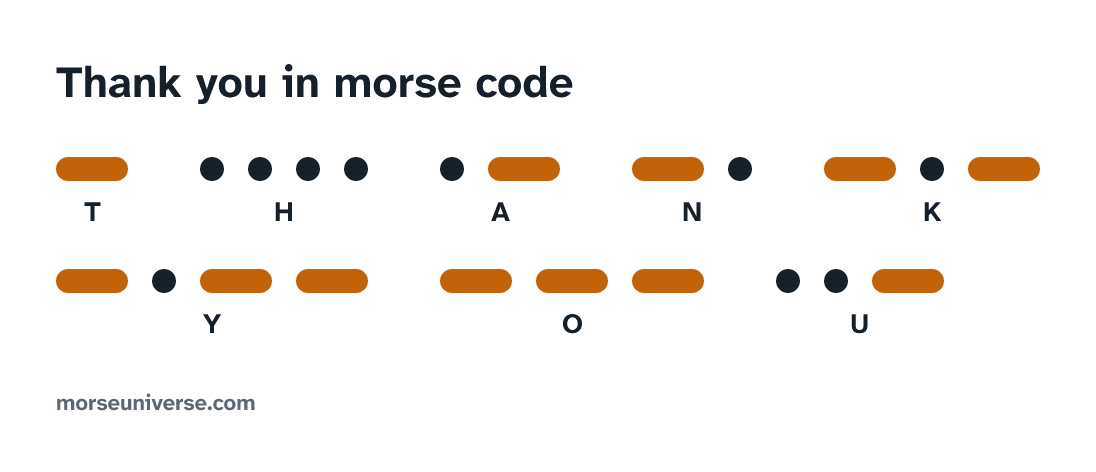
The pattern as a picture, each letter named under its marks, for a card, a craft project or a tattoo sketch. The PNG is ready to print or share; the SVG scales to any size.
Thank you as a morse code bracelet
Each dit is a round bead and each dah a tube three times as long, with a small spacer between letters. For a 7 in bracelet in 3 mm beads: 10 dit beads, 12 dah tubes, 6 spacers, 1 word bead and 9 plain beads.
How thank you is put together
THANK is T (a single dah), H (four dits), A (a dit and a dah), N (a dah and a dit) and K (a dah, a dit and a dah). YOU is Y (a dah, a dit and two dahs), O (three dahs) and U (two dits and a dah). That adds up to 22 marks, 12 of them dahs.
At 10 words per minute (WPM), the speed the player starts at, the whole phrase takes about 10 seconds. The gap between the two words is seven units of silence, more than twice the three units between letters.
TU and TNX: how radio operators say it
The International Amateur Radio Union’s operating guide lists TU for thank you and TNX for thanks. TU is four marks, a dah, then two dits and a dah, against 22 for the full phrase.
TU is also how a contest contact ends. In the guide’s example, a station sends TU and its call, which confirms the report it just received and calls for the next contact in the same breath.
Questions
What is thank you in morse code?
A single dah for T, four dits for H, then A, N and K, a longer gap, and Y, O and U. That's 22 marks, and the Copy morse button above copies it as text.
How do you say thank you in morse code with a light?
Flash it with the steps above, one letter at a time, and stay dark for seven counts between the two words. Press Play to watch the lamp keep the rhythm first.
What is no thank you in morse code?
N and O, a word gap, then thank you, 27 marks in all. No in morse code shows the first word on its own.
How do you say please in morse code?
P, L, E, A, S and E, 15 marks in all. Radio operators shorten it to PSE, which the International Amateur Radio Union's operating guide lists next to TU.
What is thank you for your service in morse code?
Thank you, then FOR, YOUR and SERVICE, each with seven units of silence before it. Type it into the morse code translator to hear it and copy it.
More morse tools
- Morse code translator
Type any text to hear it in morse, or paste morse to read it.
- Printable morse code chart
Every letter and number drawn to scale, for US Letter and A4.
- Morse code numbers
0 to 9, and the pattern that makes them quick to learn.
More phrases in morse code
- Yes in morse code
Three letters and 8 marks.
- Happy birthday in morse code
Thirteen letters in two words, 41 marks in all.
- Hello in morse code
Five letters and 16 marks, with the double L in the middle.
- Help in morse code
Four letters and 13 marks.
- Help me in morse code
Six letters in two words, 16 marks in all.
Sources
- Codes and timing follow Recommendation ITU-R M.1677-1 (10/2009), International Morse code (International Telecommunication Union, 2009).
- Ethics and Operating Procedures for the Radio Amateur (edition 3) (International Amateur Radio Union, 2010).